_工作區域-1-複本-15.png)
ESP Cable
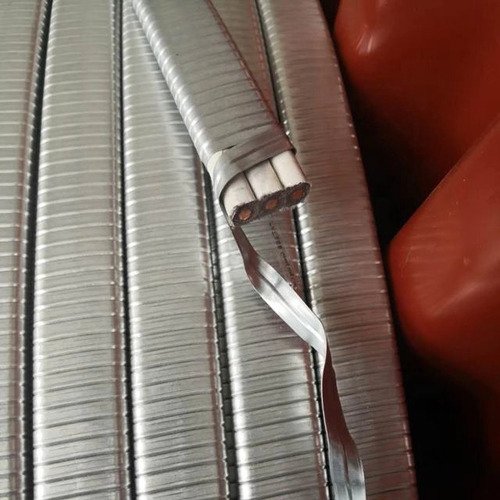
ESP Cable is a specialized power transmission line designed specifically for Electrical Submersible Pump systems.
It is engineered to provide continuous and stable power to downhole motors in environments characterized by high pressure, high temperature, and corrosive fluids (such as H2S and CO2).
Through advanced material combinations and multi-layered armor, these cables ensure superior electrical insulation while providing exceptional mechanical protection and environmental stress cracking resistance.
Our ESP cables are available in two primary geometric configurations to accommodate various completion clearances and electrical requirements.

Flat Configuration
Conductors arranged side-by-side with a slim profile.
Preferred for restricted annular spaces in small-diameter casings to minimize mechanical friction during installation.

Round Configuration
Conductors in an equilateral triangular layout.
Offers balanced electrical characteristics and superior mechanical integrity, ideal for large-bore wells with ample clearance.
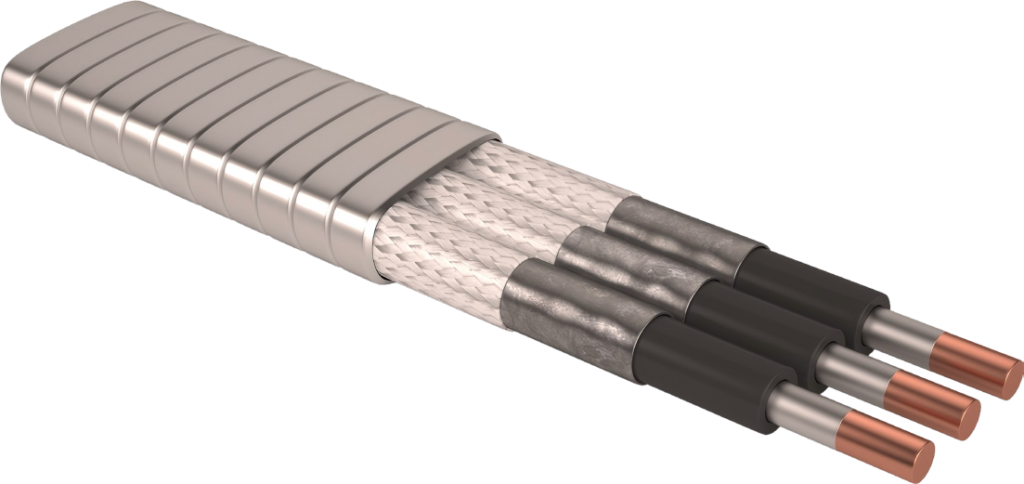
| Components | Material Options | Technical Functions |
|---|---|---|
|
Conductor
|
Solid / Stranded Copper
|
Core for power transmission; stranded type offers flexibility, while solid type provides stability. |
|
Insulation |
PP, EPDM, Polyimide |
Primary electrical insulation; selected based on well temperature (PP for 100℃, EPDM for 204℃).
|
|
Barrier / Tape |
PTFE Tape, Fabric Tape |
Wrapped over insulation to prevent expansion damage during rapid decompression. |
|
Inner Sheath
|
Lead, EPDM, NBR |
Provides a critical chemical barrier; Lead sheath offers ultimate protection against H2S ingress. |
|
Braid / Covering |
PES Braid, Synthetic Braid |
Provides mechanical reinforcement and protects inner layers from armor compression. |
|
Outer Jacket |
NBR, EPDM, HDPE |
Secondary physical protection; offers oil/heat resistance and mechanical cushioning. |
|
Armor |
Galv. Steel, SS, Monel |
Outermost mechanical protection; material selected based on wellbore corrosivity. |
Onshore & Offshore Production
Provides reliable power connectivity for ESP systems across various well depths.
High Water-Cut Wells
Ensures stable power delivery under high-volume fluid lifting conditions.
High-Temperature Deep Wells
Temperature ratings up to 232°C (450°F) to suit extreme geothermal conditions.
Corrosive Environments
Offers lead sheathing and corrosion-resistant alloy armor for wells with high H2S and CO2 concentrations.
| Parameter | Typical Range / Options |
|---|---|
|
Voltage Rating |
3 kV / 4 kV / 5 kV |
|
Conductor Size |
#1, #2, #4, #6 AWG (16 mm² – 50 mm²) |
|
Temperature Rating |
100°C (212°F) to 232°C (450°F) |
|
Armor Material |
Galvanized Steel / Stainless Steel / Monel |
|
Armor Profile Types |
1. Standard Crown (Interlocked): Max radial crush resistance.
2. Flat Profile (Interlocked): Balanced OD reduction & integrity.
3. Flat Profile (Standard): Ultra-slim design for tight clearances.
|
|
Armor Configuration |
50% Lapped & Fully Galvanized (4-sides):Ensures 100% surface coverage and superior corrosion shielding. |
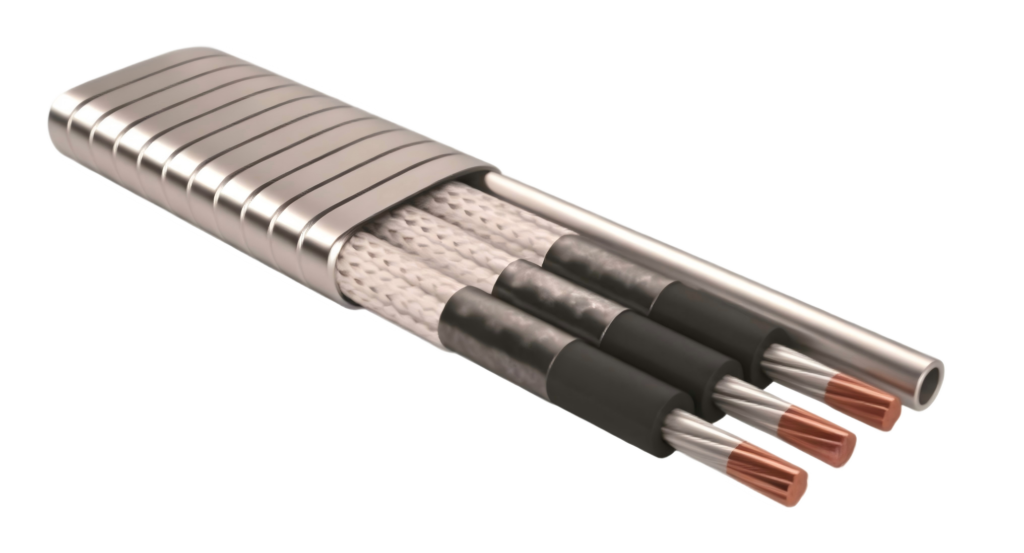
For Integrated types, capillary tube (usually is 316L and 825) can be integrated for chemical injection, pressure monitoring, or signal transmission.
High-Voltage Dielectric Testing
Verification of insulation breakdown strength to ensure reliable power delivery to downhole motors.
Thermal Cycling Analysis
Testing of the jacket and insulation materials to guarantee performance in extreme high-temperature oil wells.
Gas Migration Testing
Verification of the encapsulation’s ability to resist explosive decompression and gas permeation.